.png)
From Research to Resilience: WIL Students Share Insights on Climate Mental Health at the University of Toronto
- Nov 13, 2025
- 2 min read
Updated: Apr 17
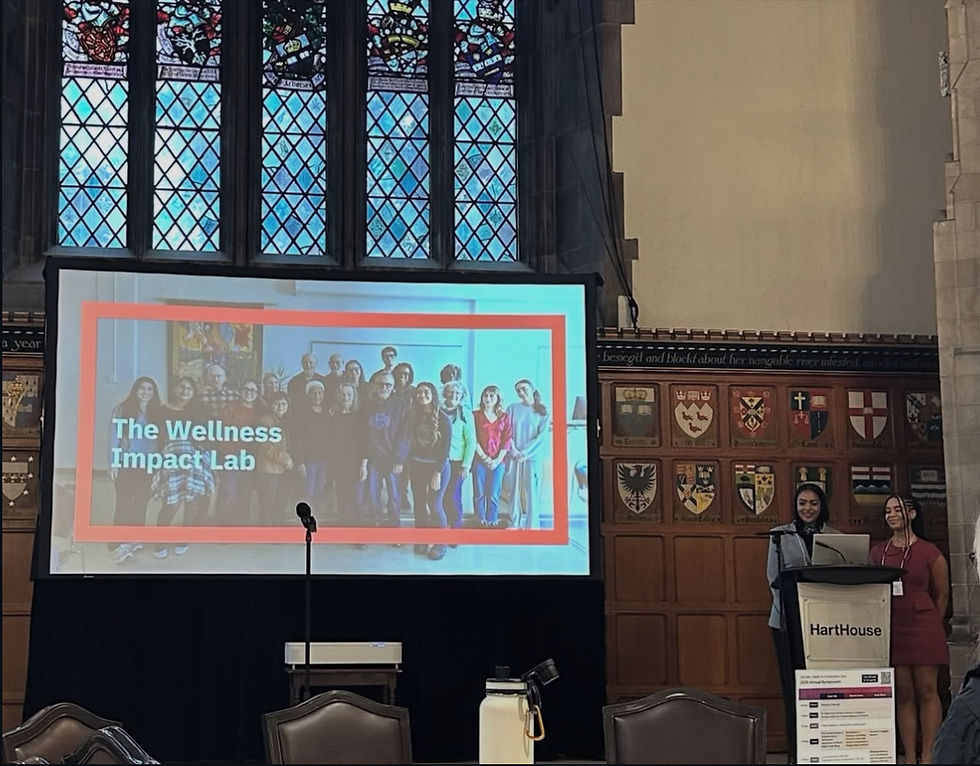
On October 30th, three of our students proudly represented the Wellness Impact Lab at the Climate, Health & Sustainable Care Symposium 2025, hosted by the University of Toronto’s Institute of Health Policy, Management, and Evaluation. The event brought together leading researchers, practitioners, and community partners to discuss innovative approaches to promoting health and well-being amid the growing challenges of the climate crisis. It was an inspiring space for dialogue on how health systems can adapt to and address climate-related impacts on communities.
Sarah Merghani and Sophia Bryan-Carbonell, joined the panel "From Climate Distress to Collective Action: Participatory Approaches for Mental Health and Well-being," moderated by Dr. Samantha Wells of the Centre for Addition and Mental Health (CAMH). Their presentation, Scaling Climate Mental Health: Evaluating the Impact of University-Based Climate Cafés, highlighted findings from York's WIL Climate Cafés and Nest Initiative; peer-led programs designed to help students process climate emotions, foster resilience, and transform distress into meaningful engagement and community action.
Merghani and Bryan-Carbonell also presented a research poster titled Evaluating University Climate Wellness Models: Lessons Learned and Future Directions, which shared preliminary evaluation data from The Nest, a student-driven project supported by the Agents of Change program at York University. Their findings emphasized the importance of creating inclusive, safe, and student-led spaces that empower young people to engage constructively with climate emotions.

From left to right, Lauren Corridore, Sophia Bryan-Carbonell, and Sarah Merghani standing in front of Bryan-Carbonell and Merghani's research poster, "Evaluating University Climate Wellness Models: Lessons learned and Future Directions."
Lauren Corridore, a Research Assistant with the Wellness Impact Lab, also represented the WIL by presenting her poster, Mindfulness-Based Approaches to Climate Distress: Fostering Inner Resilience and Environmental Engagement. Her literature review examined how mindfulness practices can help individuals cope with climate distress and support climate engagement. The review examined a diverse range of mindfulness-based initiatives (MBIs), including meditation practices, psycho-educational climate resiliency programs, and climate policy initiatives, to understand their impact on emotional wellbeing, climate self-efficacy, and pro-environmental behaviour. Across the research, mindfulness was shown to reduce stress, promote compassion and a greater connectedness with nature, and ultimately encourage greater climate concern, policy support, and sustainable action.

Interested in getting involved with The Nest Initiative?
Follow them on Instagram @thenestyu!


Comments